
 US Dollars
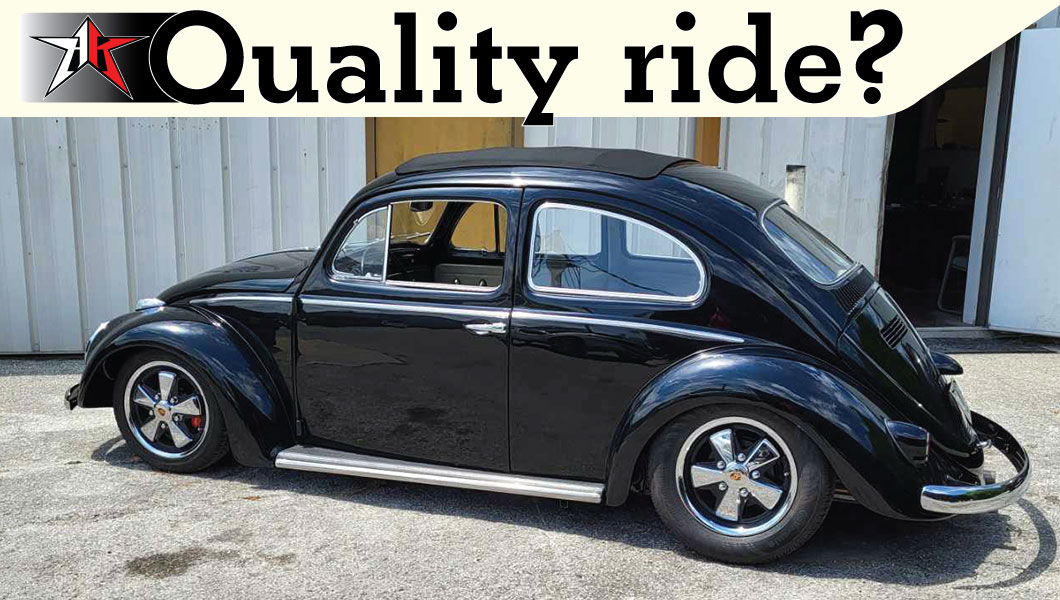
The Top 5 Things That Make a Classic VW Actually Ride Well
Quality is subjective. What feels great to one driver feels harsh, floaty, or vague to another — and that's fine. We all sit in our cars differently.
But after building thousands of front ends for Classic VW owners around the world, the PROs at Airkewld have landed on five components that show up over and over in cars that ride well — and five places where almost everyone cuts corners and pays for it later. Whether you're chasing a buttery cruiser, a tight handler, or something in between, these are the levers that move the needle.
Let's go through them.
1. Shocks
The most underrated component on a Classic VW front end. People buy shocks based on whether the collapsed and extended lengths fit the application — and stop there. That's not how this works.
A shock that fits isn't necessarily a shock that rides. This is exactly why we don't recommend KYBs for these cars. The valving was designed for something completely different, and you feel it in every expansion joint.
Here's the rough framework:
- Oil shocks ride softer.
- Most gas shocks ride stiffer.
- Adjustable shocks let you dial it in to your weight, your road, and how you actually drive.
Pick the one that matches the car you want to drive — not the one that happens to be on the shelf at the parts store.
2. Torsion Bars (Spring Rate)
In a previous article we walked through measuring your VW corner-to-corner to see if it sits straight. The reason matters here: used torsion bars are not consistent.
Think about what your bars have been through. A 350-pound owner driving 100 miles a day for ten years works the bars completely differently than a 125-pound owner doing 10 miles on Sundays. Forty or fifty years of that history is baked into every set of used torsions you'll ever buy. Left side, right side, original car, donor car — they're all different.
When you're lowering a car and you actually care about how it rides, new torsion bars are the move. Spring rate is identical side to side. No fatigue. No mystery history. Predictable, repeatable, and the foundation everything else gets built on.
3. Control Arm Movement (Bushings & Bearings)
This is the most overlooked component on the entire front end — and the one that quietly destroys ride quality on more cars than any other single part.
There are three options out there. They are not equal.
Delrin bushings (our preference). Delrin is a hard plastic — picture a heavy-duty cutting board, but engineered. It's effectively friction-free. We machine it so it indicates the entire arm for a zero-play, zero-bind fit. The arm rotates exactly how it should, every time.
Factory roller bearings with Micarta inner bushings. The OEM setup. Some early link-pin beams ran Micarta inner and outer; later beams went to outer bearings with Micarta inner. When they're properly greased, they hold up. The problem is most VW owners didn't grease them properly, so the majority of vintage arms we see have measurable wear where the bearings ride on the arm. Once that wear is there, the arm rocks. You feel it. You hear it. It's not coming back.
Polyurethane. Developed for off-road dirt and sand applications where vibration through the suspension was never the issue. Urethane squeezes — it doesn't let the arm rotate freely. It also requires a special clear lube (not available in a grease gun) applied liberally during install, because that's the only lube it'll ever see. It got popular because it's cheap. It is not what you want under a street car if ride quality is on your list.
4. Tire Pressure & Load Rating
The factory 165sr15 radial has a 1-ply sidewall. That's not a flaw — it's part of how the car was designed to ride.
A softer sidewall and lower pressure let the tire flex over imperfections in the road. Heavier sidewall plies and higher pressures pass more of that road texture straight up into the chassis. As tire diameter shrinks (think shorter aspect ratios for stance reasons), sidewall plies typically go up — which improves stability and cornering but trades away ride compliance.
There's no single right answer here. It's a balance between ride, stability, performance, and the look you're after. But the takeaway is simple: your tires and pressure choices are part of the suspension. Treat them that way.
5. Seats
Bet you didn't see this one coming.
The springs inside a stock Classic VW seat are doing real suspension work. They absorb high-frequency bumps and road irregularities before those inputs ever reach you. Swap to a thin foam-only seat — or, in the case of many Bus owners, reduce the spring count to clear wheel tubs — and suddenly you feel every expansion joint, pothole, and tar strip your front end was already filtering for you.
Same chassis. Same shocks. Same torsions. Completely different ride. The seat is the last filter between the road and your spine, and it matters more than almost anyone gives it credit for.
Putting It All Together
Shocks. Torsions. Control arm bushings. Tires. Seats. Five components, working together. Get all five right and you end up with a Classic VW that rides the way you always pictured it riding when you bought the car. Miss one — especially the bushings — and you'll feel that miss every time you drive it.
Beyond the parts themselves, how the car is assembled, lubed, and aligned matters just as much. A perfect parts list installed sloppily will still drive like a tired car. Ride quality is built one detail at a time.
Want a Second Opinion?
If you're partway into a build and something doesn't feel right — or you're about to start one and want to make sure you're spending money in the right places — talk to a PRO at Airkewld. We've spent the last 16+ years figuring out what actually moves the needle on these cars. We're happy to walk through your setup with you for free.
Start with the Ultimate Plan for a step-by-step roadmap, shop by type if you already know what you need, or browse our catalogs for tailored builds.
A great-riding Classic VW isn't an accident. It's the sum of five small decisions made well.