
 US Dollars
1966: The Year the Beetle's Suspension Changed Everything
Same body. Wider suspension. A wheel-offset trick nobody talks about — and the real reason wide-5 Beetles almost always need a narrowed beam.
Shop Assembled Narrowed Beams →The Beetle body never got any wider
From the early 1950s all the way through 1967, the Classic VW Beetle body kept the exact same width — outside fender edge to outside fender edge, side to side. That's more than fifteen years of an unchanged body shell.
Then something happened in 1966 that quietly changed the math for every Beetle built after it.
The King Pin (Link Pin) years
Beetles built from 1949 through 1965 used King Pin, also called Link Pin, front suspension. Track width — the distance from wheel to wheel — held steady across two brake-shoe generations:
Ball joints arrive — and so does a problem
In 1966, VW introduced ball joint front suspension. It was roughly 1" wider per corner than King Pin — about 2" wider overall. But the body shell didn't change. So VW had to hide those extra two inches somewhere else.
The fix was wheel offset. The 1966 & 1967 wheels were built with a higher offset, pushing the wheel barrel inboard just enough to land back at the same track width as the earlier 1958–1965 cars. Even the hub caps were redesigned so they wouldn't protrude past the fender edge.
Same look. Same stance. A completely different suspension underneath.
Your wide-5 Beetle was built around a wheel that doesn't exist anymore
The 1966 & 1967 Beetle still runs the wide 5x205mm bolt pattern. But almost every aftermarket wheel built for it — typically 15x5.5" — kicks the wheel out about 3/4" both inboard and outboard from stock.
That means any imported wheel choice pushes your wheel closer to the outside fender edge — even after you've already invested in drop spindles or a disc brake upgrade. Once you see the numbers, a narrowed beam stops being a "look" and starts being the correction the geometry was always asking for.
Wider ball-joint suspension (1966–up) + aftermarket wheel offset (built for the wider stance) = wheels sitting further outboard than a King Pin car ever did. A narrowed beam pulls that back in without giving up the spindles or brakes you've already bought.
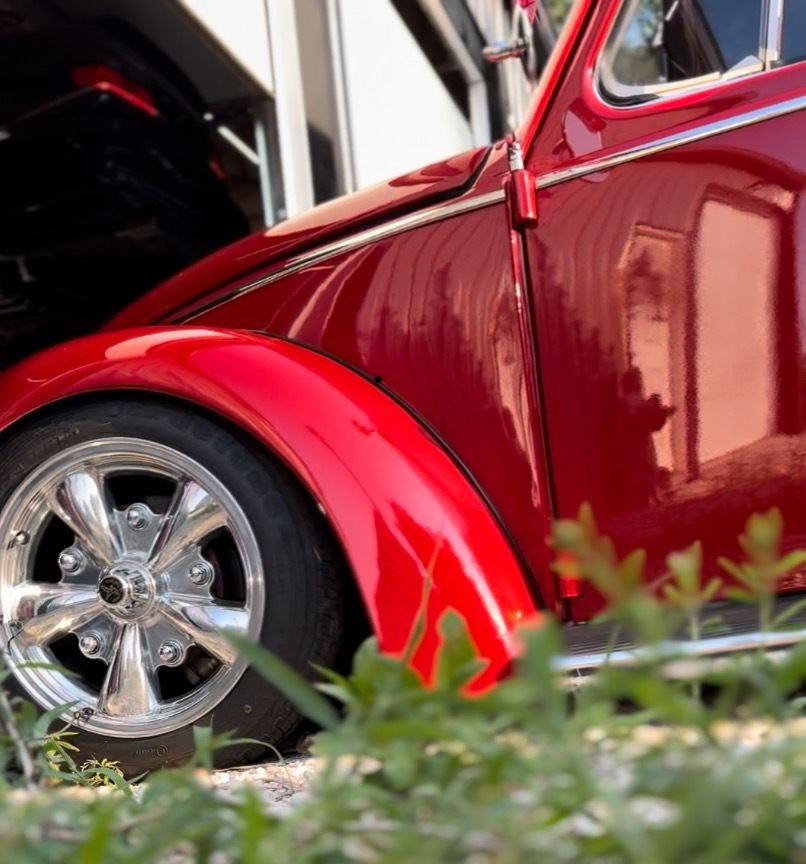
It's a math problem — here's what the numbers look like in person

Narrowed beams, answered
I already have drop spindles and disc brakes — do I still need a narrowed beam?
Spindles and brakes change how the wheel is carried, not where the beam's kingpin centerline sits. If you're running a modern 15x5.5" wheel on a wide-5 bolt pattern, the wheel is still pushed outboard by the wheel's own offset — narrowing the beam is what pulls that back in without touching the spindles or brakes you've already paid for.
What's the real difference between a 4" and a 6" narrowed beam?
It comes down to how much the wheel and tire you've chosen need to be pulled in to sit correctly under the fender. A 4" beam is a common middle ground; a 6" beam is for a more aggressive tucked stance or a wider wheel/tire combination — both keep the same spindle and brake compatibility.
Does this apply to my car if it's a 1965 or earlier King Pin Beetle?
King Pin cars started from a narrower stock track to begin with, so the offset math is different — but the same principle holds: modern aftermarket wheels are rarely built to your car's original offset, so it's worth checking your numbers before you buy wheels.
Goodyear, Arizona, USA | 623-518-3537